11-28-2007, 08:24 AM
|
This thread is in the EcoModder Project Library |
#1 (permalink)
|
|
Batman Junior
Join Date: Nov 2007
Location: 1000 Islands, Ontario, Canada
Posts: 22,515
Thanks: 4,062
Thanked 6,959 Times in 3,603 Posts
|
Aeromodding in the 1930's: 38 mpg, 70 mph Model T
Radical aeromodding of the DIY variety (e.g. basjoos' Aerocivic) isn't a new pursuit. I learned this from a friend of mine, whose father - at the age of 17 in 1933 - redesigned & fabricated an aerodynamic body for his Ford Model T.
He transformed Ford's original high-drag disaster into a narrowed, boattailed, teardrop that was faster, more efficient and arguably better looking than the original.
And fortunately for posterity, he documented the transformation in photos:
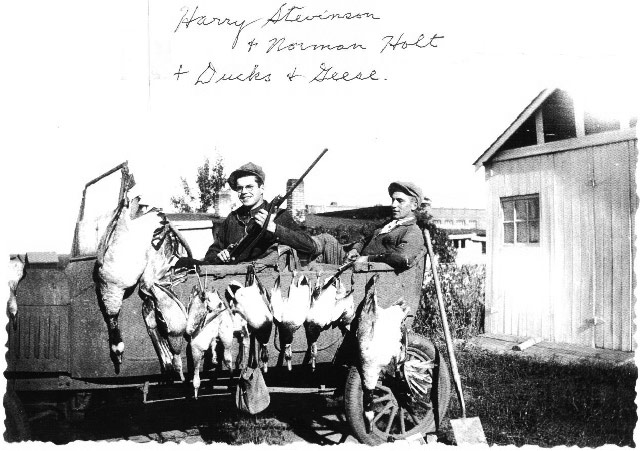
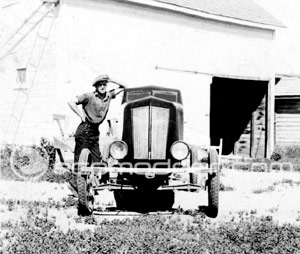
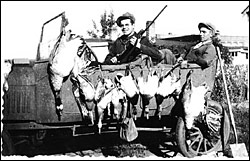 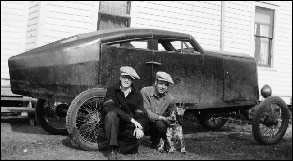 Harry Stevinson's handiwork: Before, with the original car out goose hunting;
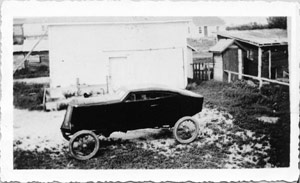
After, with the redesigned aerodynamic body.
- The end result was a custom car that would go 70 mph with its original engine. The Model T in stock form topped out around 45 mph.
- Fuel economy was similarly improved with the streamlined version. Harry reported achieving 38 mpg (US), vs. the original car's 25-30 mpg.
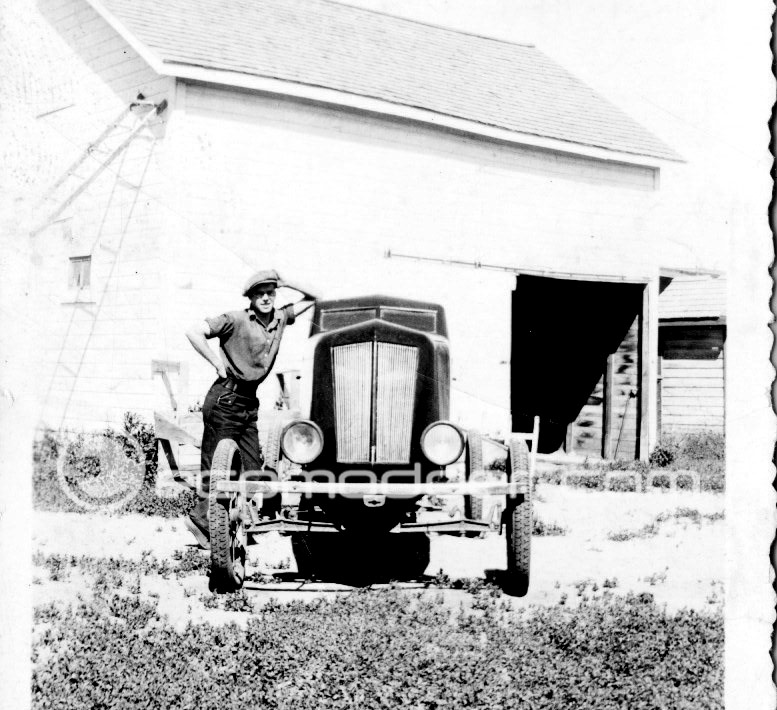
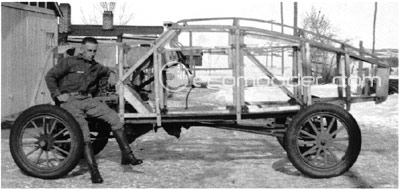 Click image to zoom - Harry posing with the project under construction
- The body was built over wood frame & stringers, wood floor
- 4 person seating, 2 front, 2 rear
In the above image you can see the other major mod that improved the vehicle's efficiency: Harry installed a second transmission from a Chevrolet, inline behind the original Model T unit. This gave the car 7 forward speeds, and 5 reverse.
Of course not all the gear combinations would have been practical or even usable, but with some experience and forethought, the driver could pick the best one for the job.
Stopping the car was done using the transmission's service (shaft) brake and downshifting, rather than the stock Model T's rear drum brakes. The brake shoes tended to get worn down quickly anyway in the Canadian prairie dust & mud.
 Click to zoom: Reduced frontal area... and custom grill.
- despite small windshield area, forward visibility was fine since the driver sat close to the glass
- a gas torch served as the front window defroster
Harry's efficiency interests didn't stop with the aero Model T. In later years, he equipped an Oldsmobile with a basic fuel economy meter: a graduated glass cylinder (in the cabin) which fed fuel to the carburetor. He used it to monitor fuel consumption on the road.
Harry was also an early adopter of the original VW Beetle. Even then, he was aware of its missed potential: despite its relatively good fuel efficiency (for its time), his son Tom tells me he remembers Harry explaining that its poor aerodynamics held it back from even better MPG.
The guy was a true ecomodding pioneer.
---
For those who are interested, I posted the original version of this story on MetroMPG.com, where you can find more info than appears here.
|
|
|

|
|
The Following 11 Users Say Thank You to MetroMPG For This Useful Post:
|
aero84 (04-05-2011), California98Civic (05-28-2012), Daschicken (07-03-2020), Geo Metropolis (12-31-2011), JohnAh (11-26-2014), Jyden (02-14-2010), Laurentiu (01-17-2010), niky (05-28-2012), Piwoslaw (10-15-2009), thatguitarguy (12-06-2009), whatmaycome14 (11-25-2015) |
 Today Today
|
|
|
|
 Other popular topics in this forum...
|
|
|
|
|
11-28-2007, 08:27 AM
|
#2 (permalink)
|
|
Batman Junior
Join Date: Nov 2007
Location: 1000 Islands, Ontario, Canada
Posts: 22,515
Thanks: 4,062
Thanked 6,959 Times in 3,603 Posts
|
I asked my friend Tom (Harry's son) why he didn't put fairings on the wheels - it seems like the most obvious oversight.
He asked his dad the same thing - and the answer is they were left off because there weren't many paved roads where he lived, and in the wet weather, the muck would have filled the fender wells and hardened to cement. (The "original" version of the car had its fenders removed too.) |
|
|
|
|
11-28-2007, 08:28 AM
|
#3 (permalink)
|
|
Batman Junior
Join Date: Nov 2007
Location: 1000 Islands, Ontario, Canada
Posts: 22,515
Thanks: 4,062
Thanked 6,959 Times in 3,603 Posts
|
He truly was a pioneer. He was building his car ahead of some of the more famous early aerodynamic cars:

Tatra T77 (1934), Dymaxion car (1933), Chrysler Airflow (1934)
The 30's really did see an explosion in aerodynamic design investigation.
PS...
--------------------------------------------
More aeromodded vehicles featured at Ecomodder...
|
|
|
|
|
12-30-2007, 11:50 AM
|
#4 (permalink)
|
|
Batman Junior
Join Date: Nov 2007
Location: 1000 Islands, Ontario, Canada
Posts: 22,515
Thanks: 4,062
Thanked 6,959 Times in 3,603 Posts
|
FYI, I've updated the original post with better pics & links to higher quality images.
|
|
|
|
|
12-30-2007, 02:32 PM
|
#5 (permalink)
|
|
MechE
Join Date: Dec 2007
Location: Bay Area
Posts: 1,151
Thanks: 0
Thanked 21 Times in 18 Posts
|
Very cool 
But it almost makes me sad to hear the orginal model T got 25-30mpg :/
That's an awesome project though
__________________
Cars have not created a new problem. They merely made more urgent the necessity to solve existing ones.
|
|
|
|
|
12-30-2007, 04:08 PM
|
#6 (permalink)
|
|
EcoModding Apprentice
Join Date: Dec 2007
Location: Melbourne
Posts: 152
Thanks: 0
Thanked 7 Times in 7 Posts
|
Quote:
Originally Posted by trebuchet03

But it almost makes me sad to hear the orginal model T got 25-30mpg :/
|
Isn't CAFE standards at 27.5mpg?
How far we've come...
__________________
"Every body perseveres in its state of being at rest or of moving uniformly straight forward, except insofar as it is compelled to change its state by force impressed." - Isaac Newton
|
|
|
|
|
The Following User Says Thank You to newtonsfirstlaw For This Useful Post:
|
|
|
01-03-2008, 08:39 PM
|
#7 (permalink)
|
|
Less IS more!
Join Date: Jan 2008
Location: St-Ours
Posts: 61
Thanks: 0
Thanked 4 Times in 4 Posts
|
I love it, I love It , I love it!
I'm building something along those lines, but in a torpedoe roadster style with a boatail body of bird's eye maple.
Something simple ....32 Chevrolet chassis....58 racing 3.5S Jaguar engine, hydraulic brakes, stainless roller bearing king pins for the original wheels....you will hear about it.....maybe a book. The name: Bois De Boulogne...please keep tuned. The chassis has been primed and the next step is mating the 5 speed tranny (with electric overdrive) to the Mazda pick-up differential. You see, I needed something with the original 6 wheel studs....with hydraulic braking power. Mazda not only had it, but would you believe exactly as the same width as the original Chevy rear diff?
As it will be used sparingly and for showing off my wooden box company, I don't feel guilty. Yet.
Frederick, pres. Wooden You Box It inc.
__________________
Less IS more !
|
|
|
|
|
01-03-2008, 09:17 PM
|
#8 (permalink)
|
|
Turbo gas guzzler
Join Date: Dec 2007
Location: Lexington
Posts: 67
Thanks: 0
Thanked 0 Times in 0 Posts
|
Quote:
Originally Posted by newtonsfirstlaw
Isn't CAFE standards at 27.5mpg?
How far we've come...
|
dont forget about all those weight penalties due to crash safety and stuff. and the fact that the model T couldnt drive on the highways, or start itself without a crank. |
|
|
|
|
01-03-2008, 09:25 PM
|
#9 (permalink)
|
|
Dartmouth 2010
Join Date: Nov 2007
Location: Hanover, NH
Posts: 6,447
Thanks: 92
Thanked 122 Times in 90 Posts
|
Quote:
Originally Posted by jazzie604
dont forget about all those weight penalties due to crash safety and stuff. and the fact that the model T couldnt drive on the highways, or start itself without a crank.
|
That's often mentioned when people lament the lack of progress in fuel economy, but then you have to ask yourself why we've obviously progessed so much in every category but fuel economy...The only real answer is that we've never tried to progress much anywhere else. CD players, ABS, heated steering wheels, but fuel economy? nah,  |
|
|
|
|
01-03-2008, 09:28 PM
|
#10 (permalink)
|
|
MechE
Join Date: Dec 2007
Location: Bay Area
Posts: 1,151
Thanks: 0
Thanked 21 Times in 18 Posts
|
Quote:
Originally Posted by newtonsfirstlaw
Isn't CAFE standards at 27.5mpg?
How far we've come...
|
New CAFE is 35mpg by 2020
Quote:
|
dont forget about all those weight penalties due to crash safety and stuff. and the fact that the model T couldnt drive on the highways, or start itself without a crank.
|
Just for future reference... The original model T weighed in at around 1200 pounds and the later year model T's with all steel construction weighed 1500lbs.... In any case, on a flat road, constant velocity - there's no weight penalty :/
__________________
Cars have not created a new problem. They merely made more urgent the necessity to solve existing ones.
|
|
|
|
|