02-28-2008, 07:48 PM
|
#21 (permalink)
|
|
MP$
Join Date: Jan 2008
Location: Ohio
Posts: 488
|
Quote:
Originally Posted by dcb
Or you could use a supermid ($170) and just figure out how to get the marble signal to look like injector pulses. The RPM displayed would be way off (and possibly the duty cycle), and it is only in metric units currently, but it would be a lot smaller than a laptop.
http://www.greenhybrid.com/discuss/f...-1-t-1-a-3015/
|
speaking of pulse, would the supermid read the pulse from this fuel pump proportional to fuel volume. this type turns on below 2 psi and turns off at 4 psi. duration wouldn't change but frequency would increase and decrease with fuel usage.
http://www.facet-purolator.com/solidstate.asp
personx, what psi do need for your carburetor?
Last edited by diesel_john; 02-28-2008 at 07:57 PM.
|
|
|
|
02-29-2008, 10:41 PM
|
#22 (permalink)
|
|
Master EcoModder
Join Date: Feb 2008
Location: 3rd rock
Posts: 1,310
|
I'm having an epiphany in slow motion here.
I don't know if that pump will squirt out the exact same amount of fuel with each stroke/revolution, not like a gerotor pump would, but it might be close enough.
But if a pump (any pump) can turn on and off by itself within a pressure range as needed, then perhaps it is simpler and also "close enough" to just keep track of how long the pump has actually run. I.e. an 12 volt analog clock in parallel with the pump for proof of concept. It wouldn't be terribly instantaneous, but would be good for a trip. I think I'll have to try that, maybe a vacuum guage can close the gap on the lack of instant mpg.
therefore we have: miles traveled/(total seconds pump was on ON * average gallons per second the pump moves when installed)
Just have to log the start time, and the start miles and see how close it is at the next fillup to figure out gallons per second the pump is moving.
|
|
|
|
03-01-2008, 11:33 AM
|
#23 (permalink)
|
|
MP$
Join Date: Jan 2008
Location: Ohio
Posts: 488
|
this bike computer is less than 20 bucks and it can count magnetic pulses per hour. so you would have "live" fuel volume per hr.
http://www.cateye.com/sites/cateye/u...s/en/VL500.pdf
so i borrowed the little woman's speedometer off her bike and placed it next to an operating fuel pump, and the display says i going 175 km/hr.
on the bike there is a lower limit on speed, below which, the display goes to zero. this occurs at 2 Hz more testing is needed to determine if the pump will trigger the counter at vary low volumes. or what the flow rate is at 2 Hz. i am thinking make the volume of the pipe after the pump very non-compressible so that the accumulated pressure drops rapidly, there by
causing the pump to cycle on and off (short cycle) for a small volume of fuel.
this bike computer has better spec's, if they are true. $22 (topeak 130)
http://www.topeak.com/sub/documents/M-TPC3-GB-5-05.pdf
Last edited by diesel_john; 03-01-2008 at 10:51 PM.
|
|
|
|
03-01-2008, 04:24 PM
|
#24 (permalink)
|
|
Master EcoModder
Join Date: Feb 2008
Location: 3rd rock
Posts: 1,310
|
Quote:
Originally Posted by diesel_john
this bike computer is less than 20 bucks and it can count magnetic pulses per hour. just tell it you have a big wheel for more resolution
http://www.cateye.com/sites/cateye/u...s/en/VL500.pdf
so i borrowed the little woman's speedometer off her bike and placed it next to an operating fuel pump, and the display says i going 175 km/hr.
|
That's awesome
Hey, does that pump shut off when the pressure is reached or does it just keep running?
|
|
|
|
03-03-2008, 08:41 PM
|
#25 (permalink)
|
|
MP$
Join Date: Jan 2008
Location: Ohio
Posts: 488
|
this version of the pump i have does not shut off, it runs continuosly when i dead head it with a needle valve. so i am looking around for an oil pressure switch or something i can throw in line with it. then i can check different flows vs. time.
|
|
|
|
03-04-2008, 01:46 AM
|
#26 (permalink)
|
|
Master EcoModder
Join Date: Feb 2008
Location: 3rd rock
Posts: 1,310
|
Wow, you've got it all set up there. Course we are up to $80 with pump/bike computer/pressure switch.
I really like the bike computer idea, they are like $10 at my local store. Even if it is just fuel consumption and not mpg it can be real useful on a regular route. It could be adapted to optical operation easily enough.
Perhaps, with a "marble", or turbine, or paddlewheel, or?? optical arrangement in the fuel flow, and some fudging with the wheel size adjustment on the bike computer, it could be possible to come up with a useable fuel consumed number (or factor of 10 number) in the distance travelled display (or the current consumption rate in the mph display).
Google check time: the bike computer idea is tried, with a $60 sensor. The second link has a schematic:
http://11109.rapidforum.com/topic=11...6&search=sigma
http://diverse.freepage.de/cgi-bin/f.../fuelmeter.htm

|
|
|
|
03-04-2008, 02:00 AM
|
#27 (permalink)
|
|
Master EcoModder
Join Date: Feb 2008
Location: 3rd rock
Posts: 1,310
|
Note: it specifies .025L/min on the low end of the sensitivity range on that sensor. It won't even notice my 250 idling.
|
|
|
|
03-04-2008, 03:15 AM
|
#28 (permalink)
|
|
MP$
Join Date: Jan 2008
Location: Ohio
Posts: 488
|
so lots of options on a display but the inexpensive flow meter prob. remains.
the pressure sw idea is proof of concept with the stuff i have. the on/off pumps are in the $40 range. i am just interested in how much fuel would need to be bleed off to lower the line pressure from say 4 to 2. that pump needs to restart a couple times a second for the frequency to be high enough to trigger the bike computers.
the close tolerances on the small flow meters keeps the cost up.
|
|
|
|
03-04-2008, 10:23 PM
|
#29 (permalink)
|
|
Master EcoModder
Join Date: Feb 2008
Location: 3rd rock
Posts: 1,310
|
Ok, here is a thought, kind of plays on the drip idea, basically use a bike computer or whatever to keep track of metered units of gas. No real tight tolerances required except the solenoid valves need to work. Now just an electrical problem Again!  Will be near-real time depending on capacity of the resivoir and flow, I'm fine with a 10 second delay at full throttle myself if the valves will last 10 times longer as a result.
Assuming circuitry to make it all work (the controller), theory of operation:
start state: valve B is closed, valve A is open, fuel is flowing into the chamber and raising float C.
1. opto-coupler d1,d2 is interrupted by the float and the controller closes valve A and opens Valve B. The float begins to decend.
2. opto-coupler e1,e2 is interrupted by the float and the controller closes valve B and opens Valve A and sends a trigger to the counting device (i.e. bike computer).
3. goto 1
Still need to sort out venting the resivoir when the float is supposed to be moving...
|
|
|
|
03-05-2008, 12:46 AM
|
#30 (permalink)
|
|
MP$
Join Date: Jan 2008
Location: Ohio
Posts: 488
|
reminds me a little bit of the old style gas pump, where they pump how much you want up in the glass cylinder on top to measure it, and then let it drain down into your tank. don't see why it wouldn't work, gets around the low flow problems, and some of the sloshing problems.
i was sort of kidding when i said we could count the drops like an IV dripper, but the way you got those photo sensors mounted it would count the drops, just like my planter counts every seed it plants with an infrared sensor and IR light. might have to put a little dye in the fuel to make it show up better.
on those bicycle computers, do they just have a reed switch inside or a mag. pickup? because a reed sw might be vibration sensitive.
dcb, how did you draw that?
Last edited by diesel_john; 03-06-2008 at 02:01 AM.
|
|
|
|
03-06-2008, 01:58 AM
|
#31 (permalink)
|
|
MP$
Join Date: Jan 2008
Location: Ohio
Posts: 488
|
well i tried in vain tonight to get a bike computer to read the magnetic pulses from 12v solid state fuel pump. the digital odometer would not follow the increasing and decreasing frequency of the pump consistantly when i varied the flow with a needle valve. i had the pump cycling on and off between 2 and 4 psi pressure. but when it turned on each time it had to make 5 or 6 thumps to catch back up to 4 psi. and the bike computer counted those 5 or 6 pulses as 100 or 120 MPH instead of the actually fuel being delivered which was 20 or 25 MPH. the other style pumps that are longer and cylindrical might pump more volume in one stroke an work better, also the pressure switch i was using had a 2 psi delta that i couldn' easliy narrow. with a 1 psi or less delta and a higher volume per thump and it might work.
|
|
|
|
03-06-2008, 06:55 AM
|
#32 (permalink)
|
|
Master EcoModder
Join Date: Feb 2008
Location: 3rd rock
Posts: 1,310
|
I thought the fuel delivered would have been in the distance travelled, don't know how usefull mph will be without the flow sensor. But if it is still off by a factor of four on distance travelled, then maybe see if you can tell the bike computer that the "wheel" is 4 times smaller in circumference.
The bike computer I had, the sensor would click when I brought the magnet near itm so assuming it was a reed type.
p.s. picture was done in paintbrush, saved to .gif
|
|
|
|
03-06-2008, 08:20 AM
|
#33 (permalink)
|
|
MP$
Join Date: Jan 2008
Location: Ohio
Posts: 488
|
distance times a constant would be gallons but i never got that far, because MPH wouldn't track GPH. MPH times the fudge factor is GPH. the concept has not been dispproven.
|
|
|
|
03-12-2008, 02:56 AM
|
#34 (permalink)
|
|
MP$
Join Date: Jan 2008
Location: Ohio
Posts: 488
|
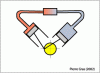
who, had a pic of the Zemco flow meter. The part on the left is the recirculating ball flow meter.
|
|
|
|
03-12-2008, 08:26 AM
|
#35 (permalink)
|
|
Awesomeness personified
Join Date: Dec 2007
Location: Columbia, MO
Posts: 627
|
__________________
"I got 350 heads on a 305 engine. I get 10 miles to the gallon. I ain't got no good intentions." - The Drive By Truckers.
|
|
|
|
03-12-2008, 09:19 AM
|
#36 (permalink)
|
|
MP$
Join Date: Jan 2008
Location: Ohio
Posts: 488
|
Quote:
Originally Posted by AndrewJ
|
thanks, AndrewJ I'll watch it. John
it sold for $25plus 6 shipping with a few seconds to go.
Last edited by diesel_john; 03-13-2008 at 10:52 PM.
|
|
|
|
03-20-2008, 11:37 PM
|
#37 (permalink)
|
|
MP$
Join Date: Jan 2008
Location: Ohio
Posts: 488
|
to summarize so far we have found that some Zemco flow meters are still on ebay and selling for $25 to 30. the output is frequency proportional to fuel flow.
dcb
has found a circuit diagram to convert pulses from a flow meter to a bike computer for measuring mileage on a carb'd engine.
http://diverse.freepage.de/cgi-bin/f.../fuelmeter.htm
also a site showing a bike computer displaying mileage.
http://11109.rapidforum.com/topic=11...6&search=sigma
This makes it possible to measure to mileage of a carb'd engine for about $100 to $120. which is still above our price goal.
|
|
|
|
04-18-2008, 01:21 AM
|
#38 (permalink)
|
|
MP$
Join Date: Jan 2008
Location: Ohio
Posts: 488
|
parts dissaembly of recirculating ball flow meter
I found the old flow meter and it looks like it wouldn't be to hard to fix.
Also found old feeding metering pump.
pic 1 both halves of meter showing hole for the light source on left half, mount for photo resistor on right half.
pic2 input side showing flow damper and metering jet
pic 3 also found a precision flow up to 295ml/hr. (tube stretched over rollers measures the fluid.)
pic 4 drop detector assembly for the medical flow meter
Last edited by diesel_john; 05-26-2008 at 03:41 PM.
|
|
|
|
04-18-2008, 09:31 AM
|
#39 (permalink)
|
|
Master EcoModder
Join Date: Feb 2008
Location: 3rd rock
Posts: 1,310
|
Cool, what is the diaphram about? Is inlet pressure applied to the non-spring side?
I just realized looking at this that the "marble" is probably the same "density" as gasoline. A heavy marble might not be as accurate, it would have too much inertia, and tend to sink to a low spot, and a light one would tend to float.
|
|
|
|
04-18-2008, 10:59 PM
|
#40 (permalink)
|
|
MP$
Join Date: Jan 2008
Location: Ohio
Posts: 488
|
Quote:
Originally Posted by dcb
Cool, what is the diaphram about? Is inlet pressure applied to the non-spring side?
I just realized looking at this that the "marble" is probably the same "density" as gasoline. A heavy marble might not be as accurate, it would have too much inertia, and tend to sink to a low spot, and a light one would tend to float.
|
yes, the spring pushes against inlet pressure.
The diaphram is an accumulator to damp the fuel pump pulses. Providing a more constant pressure to the restricting nozzle. Which is just brass jet.
The correct ball was made of hard plastic or rubber and was the same density as gasoline. It melted either from heat or fuel. the ball needs to be opaque. The ball in the photo is for illustration purposes. It is from a straight pin and the wrong material. I am looking for a black 0.250" glass or plastic ball.
the light source failed and I am going to replace it with a LED. But even with a ball bearing in inside and my flashlight, I can get the display to count fuel by blowing thur it.
I am going to put it on my mechanical injected diesel.
Last edited by diesel_john; 05-26-2008 at 03:41 PM.
|
|
|
|
|