07-12-2011, 08:56 AM
|
#1 (permalink)
|
|
needs more cowbell
Join Date: Feb 2008
Location: ÿ
Posts: 5,038
Thanks: 158
Thanked 269 Times in 212 Posts
|
Why so many rounded corners on the TE?
Looking at yet another vortex thread, I was reminded that while automakers go to some length to trip the flow over the top of the car smoothly with a sharp transition, they still have rather large radiui on the sides of a few inches?

So I still don't get how sharp transition is good for the top and radiused is good for the sides. My hunch-made-in-ignorance is that the radiused sides improve crosswind handling at a slight aero penalty, and possibly it is partly aesthetic, and rounded corners on the rear bumper make some sense as well, if you do any bumping. Is it because the top is generally tapered where the sides are not? That is harder yet to comprehend.
Has anyone ever actually tested sharp vertical corners? There are a few seemingly conflicting opinion pages, but I have yet to see results.
__________________
WINDMILLS DO NOT WORK THAT WAY!!!
|
|
|

|
 Today Today
|
|
|
|
 Other popular topics in this forum...
|
|
|
|
|
07-12-2011, 09:24 AM
|
#2 (permalink)
|
|
needs more cowbell
Join Date: Feb 2008
Location: ÿ
Posts: 5,038
Thanks: 158
Thanked 269 Times in 212 Posts
|
fwiw, my only point of reference is in RC land, where they say never ever round off the trailing edges.
FLUTTER
__________________
WINDMILLS DO NOT WORK THAT WAY!!!
|
|
|
|
|
07-12-2011, 12:00 PM
|
#3 (permalink)
|
|
Master EcoModder
Join Date: Mar 2009
Location: Northeast Ohio
Posts: 269
Thanks: 0
Thanked 16 Times in 16 Posts
|
I think it is mostly aesthetic. Plus the plastic bit on top is dirt cheap to make. Sharp creases in sheet metal are hard to make & even harder to repair.
That being said, I guess Harley Earl had the right idea. It turns out the tail fins made the car more aerodynamic.
|
|
|
|
|
07-12-2011, 01:02 PM
|
#4 (permalink)
|
|
Aero Deshi
Join Date: Jan 2010
Location: Vero Beach, FL
Posts: 1,065
Thanks: 430
Thanked 669 Times in 358 Posts
|
No. No. No. It turns out that a large radius actually helps Cd, and a sharp edge is good too. There is a curve/paper I've seen somewhere, too lazy to look for it now, that illustrates this . It talks about how some of the 90's cars, which were small and apparently aero, were getting lousy mileage and had high Cd's.
Turns out that if the radius is "Just Wrong" it hits a sweet spot of doom for the shape. It all has to do with the ratio between the radius of the corner vs the width of the shape in question. If anyone can find this paper, it would really fill in the blank here.
I have mentioned, a long while back, that there should be a "Sticky" or even a separate forum topic for all these helpful papers, web articles, & such on the web that are so spread out, for easy reference, and for open discussion. Actually I mentioned sticky before, but I think a whole Sub-Forum to itself would be a better thing. We have a sub forum now for HHO generators (Unicorn).....I think a "Library" forum would be nice too, we are quite the learned bunch here after all.  |
|
|
|
|
07-12-2011, 03:42 PM
|
#5 (permalink)
|
|
Master EcoModder
Join Date: Jul 2010
Location: Belgium
Posts: 4,683
Thanks: 178
Thanked 652 Times in 516 Posts
|
Quite a few cars are built with spoilers or trip-ridges built into the lights or rear bumper - sometimes standard, sometimes only in their hybrid or "eco" versions.
Hard to see at times, but they are there.
__________________
Strayed to the Dark Diesel Side

|
|
|
|
|
The Following User Says Thank You to euromodder For This Useful Post:
|
|
|
07-13-2011, 06:27 PM
|
#6 (permalink)
|
|
Master EcoModder
Join Date: Jan 2008
Location: Sanger,Texas,U.S.A.
Posts: 16,453
Thanks: 24,487
Thanked 7,421 Times in 4,808 Posts
|
sharp
Quote:
Originally Posted by dcb

Looking at yet another vortex thread, I was reminded that while automakers go to some length to trip the flow over the top of the car smoothly with a sharp transition, they still have rather large radiui on the sides of a few inches?
So I still don't get how sharp transition is good for the top and radiused is good for the sides. My hunch-made-in-ignorance is that the radiused sides improve crosswind handling at a slight aero penalty, and possibly it is partly aesthetic, and rounded corners on the rear bumper make some sense as well, if you do any bumping. Is it because the top is generally tapered where the sides are not? That is harder yet to comprehend.
Has anyone ever actually tested sharp vertical corners? There are a few seemingly conflicting opinion pages, but I have yet to see results. |
Hucho wrote about the importance or a body to have a separation point .Later in the same section he says it's not really a problem for vehicles,that they already do.
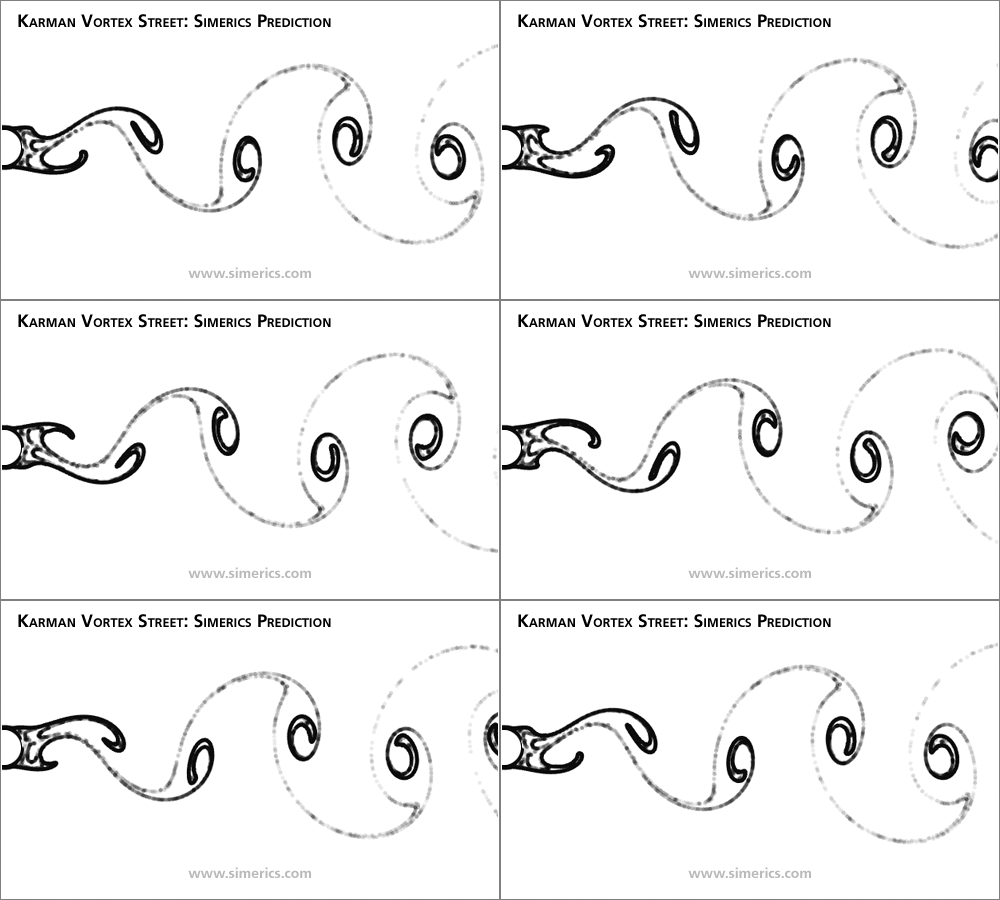
In his section on roof types he warns us to stay away from 28-degree angles,as at this angle the wake can simultaneously jump between square back and fast back type wakes ( kinda like a Karman vortex street,only in 3-dimensions ).
He does illustrate the difference edge radii can make in an aft-body,as it will be different for square back,notch back,and fast back bodies.You really need to read this whole section to ferret out the nuances presented.It's too complicated for a simple thread to cover.
I think it was an aero guy at Dodge who relatively recently reported that they prefer a 'burst' which a sharp edge can produce.There is probably a context in which he made the remark.
Kamm and Fachsenfeld promoted the 'chop',although it only really showed up in racing cars,as in Briggs Cunningham's coupe of the early 1950s,which Kamm designed for LeMans.
|
|
|
|
|
The Following User Says Thank You to aerohead For This Useful Post:
|
|
|
07-13-2011, 06:55 PM
|
#7 (permalink)
|
|
needs more cowbell
Join Date: Feb 2008
Location: ÿ
Posts: 5,038
Thanks: 158
Thanked 269 Times in 212 Posts
|
Thanks guys, looks like I should get my hands on Hucho's book. I see the IMSA library has a copy, but I should probably just get one it seems.
P.S. I thought Karman Vortex Street surely had a typo 
__________________
WINDMILLS DO NOT WORK THAT WAY!!!
|
|
|
|
|
The Following User Says Thank You to dcb For This Useful Post:
|
|
|
05-28-2012, 08:03 PM
|
#8 (permalink)
|
|
EcoModding Disciple
Join Date: May 2012
Location: Portugal
Posts: 31
ave(c)o - '08 Chevrolet Aveo (3 door) 90 day: 45.6 mpg (US)
Thanks: 8
Thanked 1 Time in 1 Post
|
So, on the sides its good to have sharp transitions, and a large radius (like a teardrop) on the top?
__________________
Keep it green!
|
|
|
|
|
05-28-2012, 08:04 PM
|
#9 (permalink)
|
|
EcoModding Disciple
Join Date: May 2012
Location: Portugal
Posts: 31
ave(c)o - '08 Chevrolet Aveo (3 door) 90 day: 45.6 mpg (US)
Thanks: 8
Thanked 1 Time in 1 Post
|
__________________
Keep it green!
|
|
|
|
|
The Following User Says Thank You to Pepperoni For This Useful Post:
|
|
|
05-29-2012, 06:26 PM
|
#10 (permalink)
|
|
Master EcoModder
Join Date: Jan 2008
Location: Sanger,Texas,U.S.A.
Posts: 16,453
Thanks: 24,487
Thanked 7,421 Times in 4,808 Posts
|
Sae
Quote:
Originally Posted by dcb
Looking at yet another vortex thread, I was reminded that while automakers go to some length to trip the flow over the top of the car smoothly with a sharp transition, they still have rather large radiui on the sides of a few inches?
So I still don't get how sharp transition is good for the top and radiused is good for the sides. My hunch-made-in-ignorance is that the radiused sides improve crosswind handling at a slight aero penalty, and possibly it is partly aesthetic, and rounded corners on the rear bumper make some sense as well, if you do any bumping. Is it because the top is generally tapered where the sides are not? That is harder yet to comprehend.
Has anyone ever actually tested sharp vertical corners? There are a few seemingly conflicting opinion pages, but I have yet to see results. |
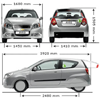
In SAE Paper #860212,FIAT evaluated a fast back,notch back,and square back and discovered that rear body radii had the greatest effect for drag reduction on fast back type cars as in your image.
Roof,back light,and rear vertical edge radii can mean -0.030 off the Cd.
The upper(and lower) edge radii are so important on fuselage that between Charles Lindbergh's 'square' Ryan Flyer and Messerschmitt's (curved) Me-109 you're looking at a difference in frontal area drag coefficients 0.27 vs 0.15,respectively.
Notch backs are the next most sensitive and square backs are the least sensitive.
Last edited by aerohead; 05-30-2012 at 05:25 PM..
Reason: spelling correction
|
|
|
|
|