05-16-2008, 10:14 PM
|
#1 (permalink)
|
|
Captain Slow
Join Date: Nov 2007
Location: Lunenburg, Nova Scotia, Canada
Posts: 6,031
|
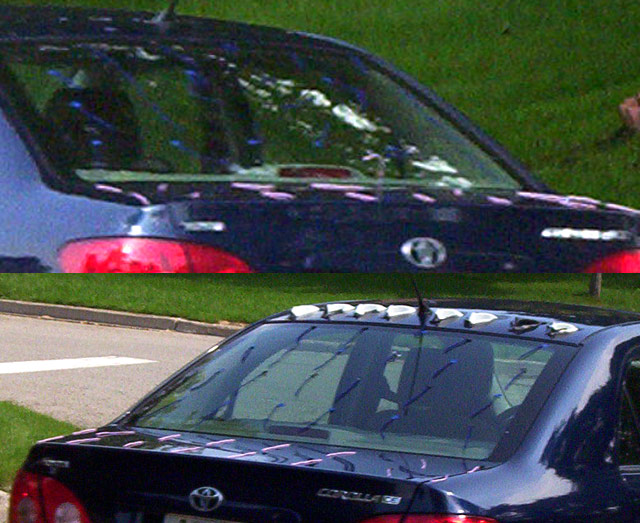
Here's the skinny on an A-B-A test @ 90 km/h on the end of the roof of a Toyota Corolla 4-door sedan automatic (2006, I believe, but have to double check).
Results in mpg (US), averages of mulitple bi-directional runs:
A - 48.9 - no airtabs
B - 48.6 - airtabs
A - 48.5 - no airtabs
I'll post up the details later.
|
|
|
|
05-16-2008, 11:19 PM
|
#2 (permalink)
|
|
(milis()/10000)%6
Join Date: Dec 2007
Location: Orlando
Posts: 1,028
|
Metro, I don't know if you plan on including it... But the standard deviation for A and B would be awesome for something like this 
__________________
Quote:
|
Challenge me, or correct me, but don't ask me to die quietly.
|
|
|
|
|
05-16-2008, 11:24 PM
|
#3 (permalink)
|
|
EcoModding Apprentice
Join Date: Mar 2008
Location: USA
Posts: 160
|
Well, Tre, with results like these, I hope you made your VGs out of cheap plastic.
Tried them on you HPV streamliner yet?
|
|
|
|
05-17-2008, 03:55 PM
|
#4 (permalink)
|
|
Captain Slow
Join Date: Nov 2007
Location: Lunenburg, Nova Scotia, Canada
Posts: 6,031
|
Raw data:
Code:
West East Avg.
A 49.1 49.3 49.2
A 49 48.4 48.7
A 48.2 48.8 48.5
A 49.1 49 49.05
B 48.2 48.9 48.55
B 47.8 48.8 48.3
B 48.3 49.1 48.7
B 48.5 49 48.75
A 48.5 48.5 48.5
A 47.8 49 48.4
A 48 49 48.5
Avg. of all A runs (7): 48.69 mpg (US)
Standard deviation of avg. of all A runs: 0.31 mpg (US)
Avg. of all B runs (4): 48.58 mpg (US)
Standard deviation of avg. of all B runs: 0.20 mpg (US)
The distribution of the data seems pretty tight. I have a good test route (next to no traffic) & had nearly ideal weather (next to no breeze).
I'm waiting (weather) for the opportunity to also tuft test the back window/trunk of this car with & without the VG's. Hopefully this weekend.
|
|
|
|
05-17-2008, 04:00 PM
|
#5 (permalink)
|
|
EcoModding Apprentice
Join Date: Apr 2008
Location: So. IN.
Posts: 187
|
can you add pics ???
|
|
|
|
05-17-2008, 04:01 PM
|
#6 (permalink)
|
|
Captain Slow
Join Date: Nov 2007
Location: Lunenburg, Nova Scotia, Canada
Posts: 6,031
|
I'll get some when tuft testing.
|
|
|
|
05-17-2008, 04:02 PM
|
#7 (permalink)
|
|
EcoModding Apprentice
Join Date: Apr 2008
Location: So. IN.
Posts: 187
|
Quote:
Originally Posted by MetroMPG
I'll get some when tuft testing.
|
cool ,,thanks
|
|
|
|
05-17-2008, 05:30 PM
|
#8 (permalink)
|
|
EcoModding Apprentice
Join Date: Jan 2008
Location: Chicagoland
Posts: 100
|
Hi Metro,
How about trying them at the front of the roof, about 6 inches back from the windshield, or even right at the top of the windshield? That is more in line with aircraft applications.
It looks like where you had them they were completely within the boundray layer and thus there was little impact.
Aerohead was saying that the flow is seperating there already. So, this makes sense. The idea at putting them forward, is that they may keep the cross section of the turbulent flow smaller.
On an 18 wheeler, my guess is that the flow is pretty laminar by the time it gets to the rear of the truck. That is, the turbulent effects have decayed, which then start up again behind the truck. I base this on driving next to trucks and watching my Prius mileage indicator. Cars are not long enough for these to have an effect on the roof above the C pillar, I do not think. Even though that is where the EVO uses them. The EVO has such a highly angled rear window, it may be pulling the bounadary layer on the roof down.
|
|
|
|
05-17-2008, 06:59 PM
|
#9 (permalink)
|
|
Legend in my own mind
Join Date: Apr 2008
Location: Sunrise, Fl.
Posts: 610
|
I found this link in an unrelated search, I hope it will help you guys on the subject .. Interesting stuff
http://www.mitsubishi-motors.com/cor...004/16E_03.pdf
__________________
Thx NoCO2; "The biggest FE mod you can make is to adjust the nut behind the wheel"
I am a precisional instrument of speed and aeromatics
If your knees bent in the opposite direction......what would a chair look like???

|
|
|
|
05-17-2008, 10:51 PM
|
#10 (permalink)
|
|
Captain Slow
Join Date: Nov 2007
Location: Lunenburg, Nova Scotia, Canada
Posts: 6,031
|
Hi Donee -
The placement of the VG's was based on the PDF that trikkoncept linked. Have a look.
Flow typically separates at the trailing edge of the roof on 3-box vehicles, so that's where VG's would theoretically help most.
That said, also note that the Mistu engineers themselves managed only a 0.006 change in Cd in their application. So even if they were helping, I would have been surprised to see any significant change in the Corolla results.
Renault also used trailing roof edge VG's on their Michelin Challenge Bibendum Logan sedan: http://forum.ecomodder.com/showthrea...179.html?t=179
It's quite possible that the Corolla's rear glass angle is already close to optimal, so wouldn't benefit much anyway. Tuft testing will help figure that out.
|
|
|
|
05-18-2008, 11:55 AM
|
#11 (permalink)
|
|
EcoModding Apprentice
Join Date: Jan 2008
Location: Chicagoland
Posts: 100
|
Hi Metro,
Yep, I have read the Mitsubishi paper, and their goal was to make their wing work better. They had a side benefit of a small amount of drag reduction, side benefit. The EVO is probably somewhat dangerous at speed, without the downforce from the wing, and the VG's.
The aircraft people use them further forward. On most commercial aircraft I have been on one can see the VG's just behind the thickest part of the wing. Yea, they are probably doing that to get them out of the 500 mph boundary layer, but just ahead of seperation at low speeds. The purpose in commercial aircraft is to provide a lower stall speed.
For cars the flow is thrown upward at the wind screen. The boundary layer is tight and laminar just before it goes over the roof on the typical car (not a Prius), but then through momentum jumps well up above the roof. If that upward momentum could be made sideways, the cross section of the boundary layer might be made less. I do not think this is a good use for a car like a Prius, but for cars with the more vertical windshields, yea it might work. This is kinda like those whale flukes, make the fluid flow go crosswise across the flat surfaces to keep it attached.
There is a thread on here which says Tubulence and Vorticity are good if they reduce the cross-section of the total disturbed air, ie the reduce effective vehicle cross section area. Otherwise, your just putting energy into wasteful flow.
|
|
|
|
05-18-2008, 01:14 PM
|
#12 (permalink)
|
|
Captain Slow
Join Date: Nov 2007
Location: Lunenburg, Nova Scotia, Canada
Posts: 6,031
|
Quote:
Originally Posted by donee
Yep, I have read the Mitsubishi paper, and their goal was to make their wing work better.
|
True - and that raises a good point: The 0.006 drag reduction they saw was after they got the wing working better (ie. probably increasing drag). Perhaps the net change without the wing might be more than 0.006.
I still don't doubt the end-of-roof placement of the VG's though. EG: Renault wasn't trying to shepherd airflow toward a wing; they only wanted to reduce drag by minimizing the size of the trailing wake - ie. moving the separation point further down the back glass.
EDIT: and the boundary thickness at the end of the roof is also mentioned in the Mitsu paper: 30 mm.
There's no flow separation at the top of the windshield on modern cars (some Jeeps, SUVs with more vertical glass notwithstanding), so VG's there won't help. Describing the flow as being "thrown upward" doesn't match what a simple photo shows:

|
|
|
|
05-18-2008, 02:37 PM
|
#13 (permalink)
|
|
(milis()/10000)%6
Join Date: Dec 2007
Location: Orlando
Posts: 1,028
|
Quote:
Originally Posted by donee
The aircraft people use them further forward. On most commercial aircraft I have been on one can see the VG's just behind the thickest part of the wing. Yea, they are probably doing that to get them out of the 500 mph boundary layer, but just ahead of seperation at low speeds. The purpose in commercial aircraft is to provide a lower stall speed.
|
It's in the right spirit, but it's really not applicable - the stall speed of a commercial aircraft is still too fast for any direct comparison to a car - not to mention, an airfoil is a streamlined body while a car is a bluff body
Quote:
Originally Posted by donee
For cars the flow is thrown upward at the wind screen. The boundary layer is tight and laminar just before it goes over the roof on the typical car (not a Prius), but then through momentum jumps well up above the roof.
|
No, Metro touched on it - but here's a little more info as this isn't the first time I've noticed this assumption. IF we assumed that fluid only entered at the base of the hood, this would be correct - this is not the case, free stream flow enters at all points, including arbitrary distances up the windscreen and AT the boundary layer level of the roof. Flow impeded by the windscreen slightly stagnates - it has less momentum compared to the mass airflow from entering free stream fluid.
Even if the windscreen is near perpendicular, we don't see a huge diversion upwards. Instead, we see stagnation and recirculation - something like this.
Quote:
Originally Posted by donee
There is a thread on here which says Tubulence and Vorticity are good if they reduce the cross-section of the total disturbed air, ie the reduce effective vehicle cross section area. Otherwise, your just putting energy into wasteful flow.
|
That may have been my thread.... If it was, I need to put more emphasis on how we're stabbing in the dark with respect to placement... There's little margin for error... It should also be mentioned, if it hasn't been already - items to perturb the flow (such as VG's) are band aids for poor aerodynamic design.
__________________
Quote:
|
Challenge me, or correct me, but don't ask me to die quietly.
|
|
|
|
|
05-18-2008, 03:00 PM
|
#14 (permalink)
|
|
EcoModding Apprentice
Join Date: Jan 2008
Location: Chicagoland
Posts: 100
|
Hi Metro and Trebuchet,
You can see what momentum effect of the air in the Jeep picture both after the hood and straight up from the windscreen.
See that one slip streem that goes up, then down, then way up again. That is the effect.
Remember the width of the car applies. So even a 1 inch decrease in flow height will be advantageous. Kinda analagous to lowering the car by one inch.
In the Jeep picture it looks like there is more like 4 inches of cross-section reduction that could be acomplished, but not with VG's.
Looking again at the Mercedes picture. Its there too. Look at the streamline that comes over the hood the closest and follow it. It disappears into the next higher streamline right at the windshield roof transistion, and both streamlines disappear and reappear further back. So, maybe 2 vertical inches of momentum effect, and then a turbulent section 1/3 the way back on the roof. It looks like there is much more tubulence in the boundary layer on the roof from there back, which just degenerates into flow seperation at the C pillar.
|
|
|
|
07-21-2008, 11:34 PM
|
#15 (permalink)
|
|
Master EcoModder
Join Date: May 2008
Location: Maynard, MA
Posts: 596
|
Hello,
Is the Corolla a sedan/saloon? How many AirTabs were used? Did any pictures get taken?
|
|
|
|
07-22-2008, 02:35 PM
|
#16 (permalink)
|
|
Captain Slow
Join Date: Nov 2007
Location: Lunenburg, Nova Scotia, Canada
Posts: 6,031
|
Hi Neil - it's a 4 door sedan. Spacing was following the distributor's instructions. No photos, sorry! I intended to get some tuft testing pics, but didn't/haven't yet.
|
|
|
|
07-22-2008, 02:56 PM
|
#17 (permalink)
|
|
Ex-lurker
Join Date: Apr 2008
Location: Jersey
Posts: 332
|
Using the snow/leaves/debris on my rear window, there's a lot of swirling that happens on the middle surface instead of laminar flow. The Flow Illustrator app seemed to show similar results with detached flow over the lower portion of the window that looks like it reattaches just at the end of the trunk lid.
Maybe I'll pick up a cheap crap camera on clearance and do some testing one day...
__________________
|
|
|
|
08-18-2008, 05:12 PM
|
#18 (permalink)
|
|
Captain Slow
Join Date: Nov 2007
Location: Lunenburg, Nova Scotia, Canada
Posts: 6,031
|
Reviving this thread...
I've finally got some photos/video of tuft testing my dad's Corolla with & without the Airtabs.
I'll just say that the difference is pretty dramatic. It's not a case of "well, it looks like there might be a little less turbulence on the rear window" - it's plain as day that the tufts on the glass & trunk lid behave themselves much better with the airtabs on the roof.
SO... why then didn't they appear to make any difference to MPG? Can the energy going into vortex creation be largely cancelling out their aerodynamic benefits apparently seen on the rear glass?
It's worth repeating that I did think there was an audible difference with the VG's on the roof (louder). If I had something I could use to easily measure noise levels, I'd test that too.
Will post the pictures later.
|
|
|
|
08-18-2008, 06:25 PM
|
#19 (permalink)
|
|
Master EcoModder
Join Date: Jan 2008
Location: Sanger,Texas,U.S.A.
Posts: 803
|
Good science! Thanks mucho.If we divide the delta Cd by the Cd of the non-VG Lancer,we'll get the percentage drag reduction for the car.Any 2% drag reduction would net the Mitsubishi owner with a 1% savings at 55-mph( 87 km/h ).
|
|
|
|
08-18-2008, 06:27 PM
|
#20 (permalink)
|
|
Master EcoModder
Join Date: Jan 2008
Location: Sanger,Texas,U.S.A.
Posts: 803
|
Your grade point average just keeps climbing,as we all give you A-plus for the project and report!!!!!!!!! Thanks Darin,really good stuff.
|
|
|
|
|