09-21-2009, 12:15 PM
|
#11 (permalink)
|
|
Master EcoModder
Join Date: Aug 2008
Location: Monroe, LA
Posts: 308
Thanks: 11
Thanked 13 Times in 12 Posts
|
I still think the location of the vent will do more to disturb your airstream than help. If the air moving down the side of the vehicle is currently attached, it will become detacted as you inject the air from the vent.
__________________
"Jesus didn't bring 'Natty Lite' to the party. He brought the good stuff."

|
|
|

|
|
The Following User Says Thank You to chuckm For This Useful Post:
|
|
 Today Today
|
|
|
|
 Other popular topics in this forum...
|
|
|
|
|
09-21-2009, 12:18 PM
|
#12 (permalink)
|
|
Master EcoModder
Join Date: Dec 2007
Location: Upstate SC
Posts: 1,088
Thanks: 16
Thanked 677 Times in 302 Posts
|
That 1939 Maybach streamliner and some of the other 1930's German streamliners vented their radiator air at about that location on the side of the car. You might look at their outlet designs.
|
|
|
|
|
09-21-2009, 02:24 PM
|
#13 (permalink)
|
|
EcoModding Apprentice
Join Date: May 2008
Location: North Texas
Posts: 112
Thanks: 0
Thanked 2 Times in 2 Posts
|
"...NACA ducts have sloped inlets that gradually broaden...
The air molecules closest to the car move at the same speed as the car. The length and shape of the NACA duct creates counter-rotating vortices that deflect the boundary layer away from the intake, but draw in the faster-moving air above it. The NACA duct is flush with the car’s surface and doesn’t significantly disrupt the streamlines of the car."
Source: Stock Car Science: NACA Ducts
_______________________
NACA Ducts
Another source using a NACA Duct and exhaust air from a human powered streamlined vehicle. Note they never discussed using a NACA duct to remove air from the vehicle.
http://www.hupi.org/HPeJ/0002/ventilation2.pdf
_______________________
NACA stands for "National Advisory Committee for Aeronautics". NACA is one of the predecessors of NASA. In the early days of aircraft design, NACA would mathematically define airfoils (example: NACA 071) and publish them in references, from which aircraft manufacturers would get specific applications
The purpose of a NACA duct is to increase the flowrate of air through it while not disturbing the boundary layer. When the cross-sectional flow area of the duct is increased, you decrease the static pressure and make the duct into a vacuum cleaner, but without the drag effects of a plain scoop. The reason why the duct is narrow, then suddenly widens in a graceful arc is to increase the cross-sectional area slowly so that airflow does separate and cause turbulence (and drag).
NACA ducts are useful when air needs to be drawn into an area which isn't exposed to the direct air flow the scoop has access to. Quite often you will see NACA ducts along the sides of a car. The NACA duct takes advantage of the Boundary layer, a layer of slow moving air that "clings" to the bodywork of the car, especially where the bodywork flattens, or does not accelerate or decelerate the air flow. Areas like the roof and side body panels are good examples. The longer the roof or body panels, the thicker the layer becomes (a source of drag that grows as the layer thickens too).
Anyway, the NACA duct scavenges this slower moving area by means of a specially shaped intake. The intake shape, shown below, drops in toward the inside of the bodywork, and this draws the slow moving air into the opening at the end of the NACA duct. Vortices are also generated by the "walls" of the duct shape, aiding in the scavenging. The shape and depth change of the duct are critical for proper operation. 
|
|
|
|
|
09-21-2009, 02:47 PM
|
#14 (permalink)
|
|
eco....something or other
Join Date: Jul 2009
Location: Colfax, WI
Posts: 724
Thanks: 39
Thanked 67 Times in 50 Posts
|
OK, wait a minute...
isn't the air behind the wheel well already turbulent???? I think the exhaust duct would help with that problem by allowing the air to exit in a smoother manner. The orientation and shape of the duct would help the air streams merge together better, right? Imagine how rough an airstream would be if you injected more air into it sideways around a corner, vs. introducing an air stream with an almost identical flow and direction. It is kind of like putting performance heads on your engine....the exhaust streams are already going in the same directin and only merge, vs. stock heads which often meet at almost right angles!!!!
Please correct me if my theory is wrong. It seems like almost anything would help the air stream at this point on the car since it can't really get worse.
__________________


1991 F-250:
4.9L, Mazda 5 speed, 4.10 10.25" rear
|
|
|
|
|
09-29-2009, 08:59 PM
|
#15 (permalink)
|
|
EcoModding Lurker
Join Date: Sep 2009
Location: Toronto
Posts: 2
Thanks: 0
Thanked 0 Times in 0 Posts
|
In my two days of researching this, I agree that NACA ducts are not for ducting out. What you want to look at is actually a NACA cowling- but use it as a slot, instead of an entire cowling.

I havent found any wind tunnel images yet, but the air around the wheel would be pretty ridiculously turbulent, making any duct less effective. If you want to vent air from the wheel well with the most power, I would suggest putting a vent in front of the well, where the air flow is more stable.
I'm just in civil engineering though, so if I find something else out then I'll post back here. |
|
|
|
|
10-01-2009, 06:41 PM
|
#16 (permalink)
|
|
Master EcoModder
Join Date: Jan 2008
Location: Sanger,Texas,U.S.A.
Posts: 16,473
Thanks: 24,500
Thanked 7,436 Times in 4,817 Posts
|
Cnr
Try Googleing Dr.Albert Morelli's CNR concept "banana car" developed at Pininfarina in the 1980s.The report on this car is the only scientific work I've encountered for exit ductwork on a car.
|
|
|
|
|
10-01-2009, 08:12 PM
|
#17 (permalink)
|
|
Ultimate Fail
Join Date: Feb 2008
Location: Austin,Texas
Posts: 3,585
Thanks: 2,872
Thanked 1,121 Times in 679 Posts
|
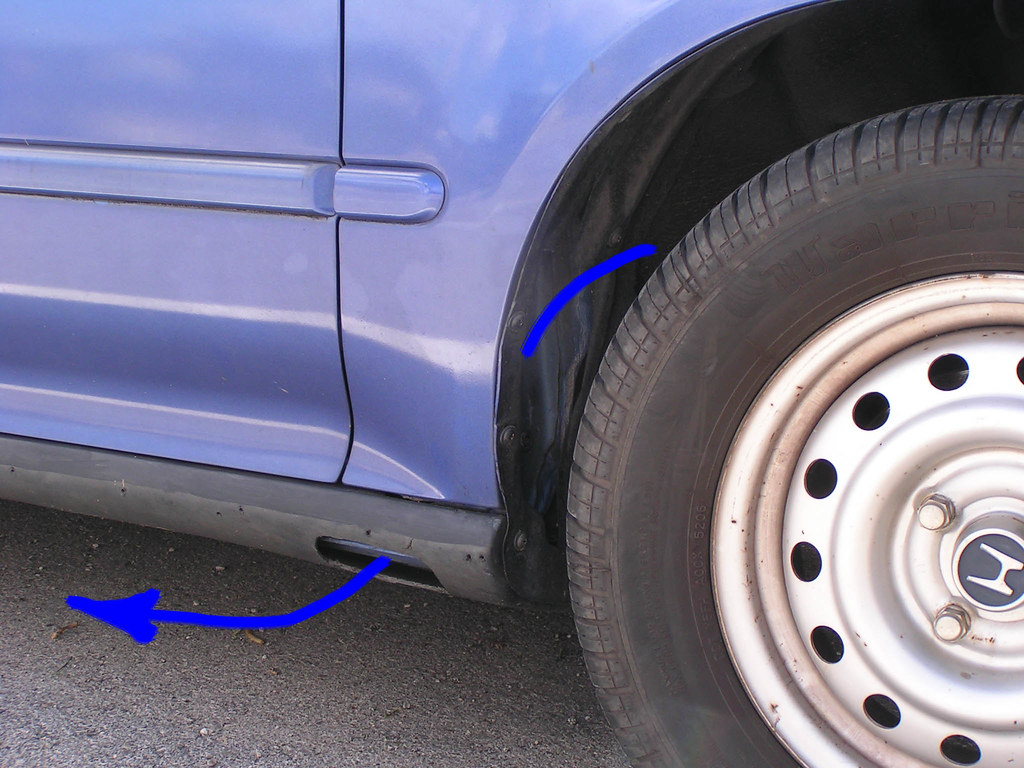
Here is my cheezy attempt at venting the air in my wheel well.
I simply cut the plastic lining and created a channel for the air to escape downwards rather than spill over the sides of the car like you see here :

I originally had some side skirts to channel the air back, but removed them.
|
|
|
|
|
10-01-2009, 11:40 PM
|
#18 (permalink)
|
|
EcoModding Lurker
Join Date: Sep 2009
Location: Toronto
Posts: 2
Thanks: 0
Thanked 0 Times in 0 Posts
|
Quote:
Originally Posted by aerohead

Try Googleing Dr.Albert Morelli's CNR concept "banana car" developed at Pininfarina in the 1980s.The report on this car is the only scientific work I've encountered for exit ductwork on a car.
|
I can't find any results. |
|
|
|
|
10-02-2009, 11:06 AM
|
#19 (permalink)
|
|
Master EcoModder
Join Date: Jul 2008
Location: Private
Posts: 282
Thanks: 2
Thanked 73 Times in 47 Posts
|
|
|
|
|
|
The Following User Says Thank You to moorecomp For This Useful Post:
|
|
|
11-01-2009, 08:11 PM
|
#20 (permalink)
|
|
Batman Junior
Join Date: Nov 2007
Location: 1000 Islands, Ontario, Canada
Posts: 22,541
Thanks: 4,085
Thanked 6,988 Times in 3,618 Posts
|
Seems to me that most (?) high-efficiency concepts that don't go with full front skirts instead pay close attention to the shape of the aft portion of the front wheel arch.
And what do they do?
They make sure they've got a generous radius in the bodywork to ensure that air exiting the wheel well has the best possible chance of staying attached. See: GM EV1, Honda Insight (1st gen.), and many, many others.
I realize this thread is about ducting, but I bet radiusing that edge (even if you simply add material to the wheel well liner) might be a much easier and workable alternative.
|
|
|
|
|
The Following User Says Thank You to MetroMPG For This Useful Post:
|
|
|